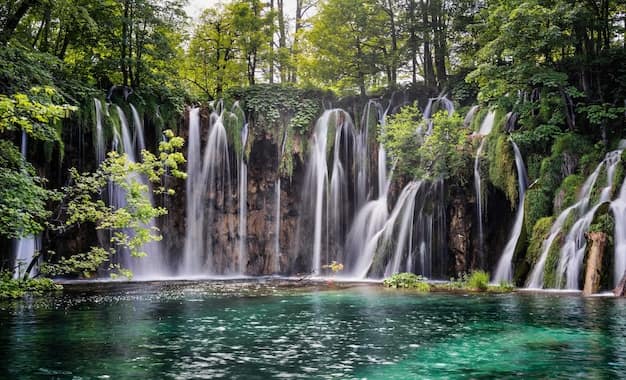
Most people meet Plitvice Lakes through a photograph — turquoise water stacked in terraces, wooden boardwalks running just above the surface, waterfalls falling from one lake into the next. The photographs are honest. What they do not tell you is that Plitvice is one of the more procedural parks in Europe to visit: timed tickets, two separate entrances, lettered walking routes, and rules enforced without much sympathy. Turning up and improvising rarely goes well.
We plan a fair number of Croatia trips out of our Surat office, and the ones that work treat Plitvice as a booked, timed appointment rather than a stop you squeeze in. This guide covers what the park actually is, how to reach it from Gujarat, what the visa looks like now that Croatia sits inside the Schengen area, and the practical details — shoes, food, children, older parents — that decide whether the day is lovely or exhausting.
What Plitvice actually is, and why the rules are strict
Plitvice Lakes National Park sits in inland Croatia, in a limestone canyon roughly between Zagreb and the Adriatic coast. Sixteen named lakes step down through that canyon, each separated from the next by a natural dam. Those dams are the whole point. They are made of travertine, sometimes called tufa — a soft, porous rock that forms when calcium carbonate dissolved in the water is deposited around moss, algae and colonies of bacteria. The living plants become the scaffolding; the rock grows around them, millimetre by millimetre.
So the barriers you are photographing are still being built — alive, and brittle. It is also why the water reads that blue-green: exceptionally clear, heavily mineralised, shifting through the day with light, depth and algae. The park splits naturally into the Upper Lakes, a broader, gentler string of pools in forest, and the Lower Lakes, which run through a narrower gorge and end at Veliki Slap, the tall waterfall most visitors come to see. Once you know the rock is fragile and still growing, every rule in the park makes sense.
Getting there from Surat, Ahmedabad and Vadodara
There are no direct flights from India to Croatia, so every routing involves at least one change. The two sensible shapes are a Gulf hub — Dubai, Doha, Abu Dhabi — onward to Zagreb, or a European connection through a major hub into Zagreb (ZAG). If you want to combine the park with the coast, flying into Zagreb and out of Split or Dubrovnik usually works better than a return into the same city. Travellers from our region usually position through Mumbai or Delhi, though we also track what is bookable on direct services out of Gujarat's own airports.
From Zagreb the park is roughly two hours by road, and that is the easy part. Buses run to the Plitvice stops and are cheap and reliable; a private transfer costs more but lets you leave early enough to be at the gate for opening. Long-haul fares move a great deal by season and booking window, so the timing tricks that genuinely reduce international airfares from India are worth applying — Croatia in July is expensive bought late.
The visa: this is a Schengen application now
This is the biggest planning change of recent years. Croatia joined the Schengen area in January 2023 and adopted the euro at the same time. For an Indian passport holder that means there is no separate national Croatian visa — a Schengen visa covers your entry, and the same visa covers the rest of the zone, which makes pairing Croatia with Italy, Slovenia, Austria or Hungary far simpler than before. If you are weighing a wider route, look at which destinations a single Schengen sticker opens up before fixing flights.
The documentation logic is standard Schengen: confirmed return flights, confirmed accommodation for every night, financial evidence, employment or business proof, and travel medical insurance meeting the Schengen minimum cover. You normally file with the consulate of your main destination — where you will spend the most nights — so a Croatia-heavy trip goes to Croatia, while a two-day Plitvice detour inside an Italy trip does not. We walk clients through the full Schengen application process as it works from Gujarat, and it pays to read the reasons applications get refused and how to reapply cleanly before you submit rather than after.
Start eight to ten weeks before departure. Appointment availability, not processing time, is usually the bottleneck in peak season. The EU has also been rolling out biometric entry and exit procedures at external borders, which can add time at your first point of entry; the details keep changing, so verify current rules before you travel. Fees and cover limits move too, which is why we avoid quoting them. For current documents and timelines see our Croatia visa requirements page for Indian passport holders, and check that your policy satisfies the medical cover Schengen expects from Indian travellers.
Tickets, entrances and the lettered routes
Here is what catches people out. Entry is by timed-entry ticket bought in advance online, and the number of visitors admitted per slot is capped in peak season. In July and August those slots sell out days ahead. There is no reliable walk-up option on a summer morning; arriving without a slot usually means being turned away or waiting hours.
There are two main gates. Entrance 1 sits at the lower end of the park, closest to Veliki Slap and the Lower Lakes. Entrance 2 sits higher up and gives quicker access to the Upper Lakes. They are not interchangeable — your ticket is tied to one, and the official walking routes are lettered A to K, each starting from a specific entrance with a stated distance and rough duration. Some are a straightforward walk; longer ones build in the electric boat across Kozjak, the largest lake, and the panoramic shuttle train along the rim.
Choose by fitness and time rather than ambition. The short routes from Entrance 1, around two to three hours, deliver the big waterfall and the most dramatic Lower Lakes boardwalks, and suit anyone with limited stamina or a tight schedule. Mid-length routes of four to six hours cover both lake systems with boat and train assistance, and are what most first-time visitors should book. Full-day options cross the whole park on foot and are genuinely long. Whichever you pick, take the earliest slot available — the first ninety minutes after opening are quieter, cooler and far better for photographs.
The rules, and why they deserve respect
Stay on the boardwalks at all times. Swimming is banned everywhere in the lakes, with no exception for a quick dip on a hot day. Drones are not permitted, pets are restricted in parts of the park, and eating is limited to designated areas. None of this is heavy-handedness — a travertine barrier that took decades to form can be damaged by a single footstep, sunscreen and body oils alter the water chemistry the algae and bacteria depend on, and food scraps change what grows where. Rangers do issue fines. Put simply, you are a guest on rock that is still being made.
Which season to choose
Spring, roughly April to June, is our usual recommendation. Snowmelt and rain mean high water and the waterfalls at their most powerful, the forest is green, and crowds have not peaked. September and October are the other strong window — thinner crowds, autumn colour through the beech woods, gentler temperatures, though water levels drop. July and August are beautiful but genuinely busy and hot, with boardwalks that feel like a queue by mid-morning; if those are your only dates, book far ahead and take the first entry slot.
Winter is a different park altogether: frozen falls, snow on the boardwalks, very few people, and a stillness some travellers prefer to the summer version. In exchange, boat and train services are reduced or suspended, several routes close, daylight is short, and conditions underfoot can be icy. It makes a wonderful second visit and a poor first one with small children.
Walking it comfortably: shoes, children and older parents
Depending on route you will walk four to eight kilometres, largely on wooden boardwalks laid directly over water. Many stretches have no handrail, the slats are uneven, and they turn slippery when wet — which, in a park built around waterfalls, is often. Wear real closed walking shoes with grip; sandals and new leather shoes are a bad idea, and we say this to every client. Carry a light rain layer and a refillable bottle. Food inside is limited to a few points and toilets exist only at set locations, so use them when you see them. Our pre-departure packing checklist for international trips covers the walking-day essentials.
For families with young children, prams are close to impossible on most of the route — a carrier works far better, and the shorter Entrance 1 loops are the realistic choice. For older parents the park is very manageable if you plan it: pick a route that leans on the boat and the panoramic train, avoid long uphill sections, go early before the heat, and accept a shorter loop rather than a six-hour one. We cover pacing and mobility questions in our guide to travelling in Europe with senior citizen parents from Gujarat.
Where to stay, and what you will eat
There are hotels inside the park boundary near the entrances, convenient and priced accordingly, and a cluster of villages just outside — Mukinje, Jezerce, Rastovaca and Grabovac — full of family-run guesthouses and apartments. The apartments are often better value and frequently come with a kitchen, which solves several problems at once. The argument for sleeping nearby rather than day-tripping from Zagreb or Zadar is simple: it lets you be at the gate when it opens. A day trip typically puts you inside at eleven in the morning, in the heat and the crowd; one night nearby changes the whole quality of the visit.
Inland Croatian cooking is meat-heavy — roasted lamb, cured meats, hearty stews. That does not make it impossible, only worth planning for. Grilled vegetables, fresh cheeses, good bread, pasta, risotto and salads are widely available, and the coast around Zadar and Split is easier still. For Jain travellers, or anyone avoiding onion and garlic, the practical answer is self-catering: an apartment with a kitchen, a supermarket stop in Zagreb or Korenica, and some familiar dry provisions from home. Carrying a day's food into the park is sensible regardless.
What it costs, in honest ranges
Croatia is not the cheapest corner of Europe, and prices swing with season. As a rough, indicative all-in figure per person from Gujarat — international flights, visa and insurance, accommodation, park entry, internal transport and meals — a 9 to 11 day Croatia trip tends to land somewhere around ₹1,60,000 to ₹2,60,000 in shoulder season, and can pass ₹3,00,000 in peak July and August or with premium hotels. Treat that as a planning bracket, not a quote. Our note on building a realistic international trip budget from Gujarat breaks the line items down, and since Croatia is now on the euro it is worth reading how to handle forex, cards and cash for a Europe trip. Sorting an international eSIM or roaming plan in advance also saves a scramble at Zagreb airport.
How Plitvice fits an itinerary
The classic shape is a north-to-south run: Zagreb, then Plitvice, then Zadar or Split, then Dubrovnik, across eight to twelve days. Two nights at Plitvice — one full park day plus the arrival evening — is the right allocation; a single rushed night works but leaves no margin for rain. If Croatia is one leg of a wider Central Europe trip, the park makes a comfortable two-day detour from Slovenia or northern Italy. For first-timers still deciding how many countries to attempt, our suggested first Europe itinerary for Indian travellers and the fifteen-day multi-country Europe route show how a park day slots in without wrecking the pace.
Planning it with us
Plitvice rewards preparation: the right entrance, route, time slot, shoes, and a bed close enough to the gate. If you would like us to build that around your dates — Schengen paperwork, flights, transfers, the park booking and the coastal leg after it — speak to our travel team in Surat and we will put a costed plan together. You can also browse our Croatia and Europe holiday packages from Surat for a starting shape. Rules, fees and entry procedures do change, so we will confirm the current position when you book.